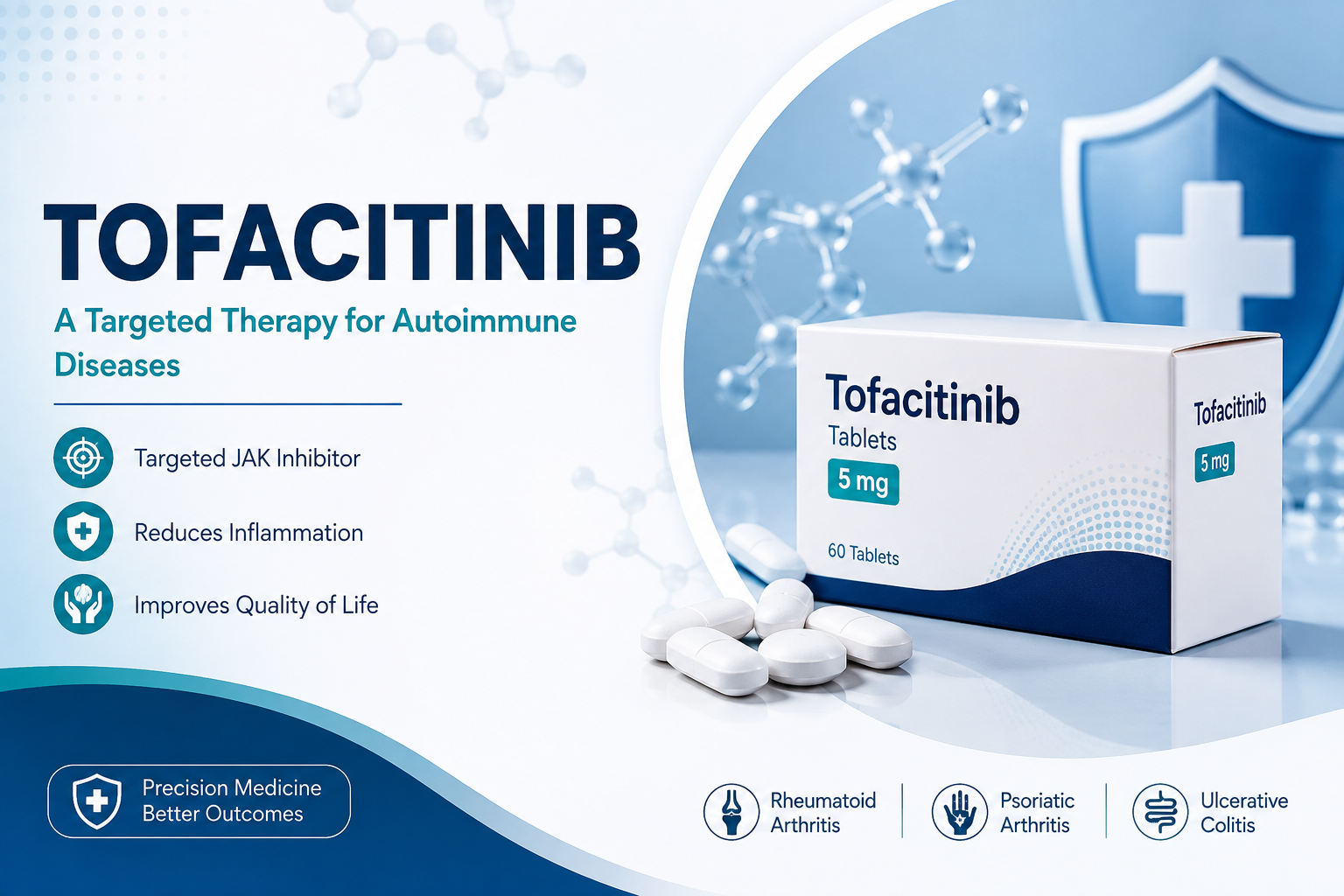


Tofacitinib is an oral targeted therapy categorized as a Janus kinase (JAK) inhibitor. It belongs to a modern class of targeted synthetic disease-modifying anti-rheumatic drugs (tsDMARDs) used primarily in the management of moderate-to-severe autoimmune and chronic inflammatory conditions. Unlike traditional biological agents that target cytokines outside the cell, Tofacitinib works inside the cell to interrupt signal pathways that trigger inflammatory cascades.
What is Tofacitinib Used For?
Tofacitinib is prescribed for adult patients (and select pediatric populations) diagnosed with specific immune-mediated inflammatory diseases. Its primary clinical indications include:
• Rheumatoid Arthritis (RA): Approved for adult patients with moderate-to-severe active rheumatoid arthritis who have had an inadequate response or intolerance to methotrexate or other disease-modifying therapies.
• Psoriatic Arthritis (PsA): Approved for adult patients with active psoriatic arthritis in combination with non-biologic DMARDs.
• Ulcerative Colitis (UC): Used for adult patients with moderate-to-severe active ulcerative colitis who have had an inadequate response or intolerance to tumor necrosis factor (TNF) blockers.
• Ankylosing Spondylitis (AS): Approved for adult patients with active ankylosing spondylitis who have responded inadequately to or cannot tolerate anti-TNF therapies.
• Polyarticular Course Juvenile Idiopathic Arthritis (pcJIA): Approved for pediatric patients 2 years of age and older with active pcJIA.
How Does Tofacitinib Work?
In autoimmune disorders, excessive signaling through cytokine receptors drives continuous joint destruction, intestinal inflammation, and systemic tissue damage.
Tofacitinib works through a targeted intracellular mechanism:
• Inhibition of JAK Enzymes: It preferentially inhibits Janus kinase 1 (JAK1) and Janus kinase 3 (JAK3), as well as JAK2 to a lesser extent.
• Blocking the JAK-STAT Pathway: By blocking these kinase enzymes, Tofacitinib prevents the phosphorylation and activation of Signal Transducers and Activators of Transcription (STATs).
• Suppressing Inflammatory Cytokines: Interrupting the JAK-STAT pathway stops the cell nucleus from receiving signals to produce key pro-inflammatory cytokines (such as IL-2, IL-4, IL-6, IL-7, IL-9, IL-15, and IL-21), thereby blunting immune system overactivity.
Benefits of Tofacitinib
• Targeted Intracellular Control: Effectively reduces pain, systemic inflammation, joint erosion, and mucosal inflammation by interrupting cellular signal transduction.
• Convenient Oral Administration: Available as oral tablets, providing a convenient alternative to frequent subcutaneous injections or intravenous infusions associated with biologics.
• Rapid Onset of Action: Clinical trials demonstrate rapid symptomatic relief and functional improvements in patients suffering from inflammatory arthritis and bowel disease.
Available Strengths
Tofacitinib is available in standard immediate-release (IR) and extended-release (ER) oral formulations to suit clinical protocols:
• 5 mg tablets (Immediate-Release)
• 10 mg tablets (Immediate-Release)
• 11 mg tablets (Extended-Release / XR)
• 22 mg tablets (Extended-Release / XR)
• Oral Solution: 1 mg/mL (primarily for pediatric dosing)
Recommended Dosage & Administration
Tofacitinib dosing depends on the patient's specific indication, formulation, liver/kidney status, and co-administered medications.
Standard Adult Dosing Guidelines:
• Rheumatoid Arthritis, Psoriatic Arthritis & Ankylosing Spondylitis:
o Immediate-Release: 5 mg taken orally twice daily.
o Extended-Release: 11 mg taken orally once daily.
• Ulcerative Colitis:
o Induction Phase: 10 mg taken orally twice daily for 8 to 16 weeks.
o Maintenance Phase: 5 mg taken orally twice daily (or 10 mg twice daily for select patients with severe disease, guided by clinical evaluation).
Administration Rules:
• Food: Tofacitinib can be taken with or without food.
• Swallowing: Immediate-release tablets may be swallowed whole; extended-release (XR) tablets must be swallowed whole and should never be crushed, broken, or chewed.
• Dose Modifications: Lower dosages (e.g., 5 mg once daily) are required for patients with moderate-to-severe renal impairment or moderate hepatic impairment.
Missed Dose
If a dose is missed, take it as soon as remembered unless it is almost time for your next scheduled dose. If the next dose is near, skip the missed tablet and return to your regular dosing schedule. Do not double up on doses to compensate for a missed tablet.
Common & Serious Side Effects
Due to its immunomodulatory nature, patients receiving Tofacitinib must be carefully monitored by their oncology/rheumatology team:
• Infections (Common to Severe): Increased risk of serious bacterial, viral, fungal, and opportunistic infections, including tuberculosis (TB) reactivation, pneumonia, and herpes zoster (shingles).
• Gastrointestinal Symptoms: Upper respiratory tract infections, headache, diarrhea, and nasopharyngitis are common.
• Cardiovascular & Thrombotic Risks: Boxed warnings highlight an increased risk of serious heart-related events (MACE such as heart attack and stroke) and blood clots (pulmonary embolism, deep vein thrombosis), particularly in older patients with cardiovascular risk factors.
• Malignancies: Increased risk of certain cancers, including lymphoma, lung cancer, and non-melanoma skin cancers.
• Gastrointestinal Perforation: Rare risk of stomach or intestinal tears, particularly in patients with a history of diverticulitis or concurrent use of NSAIDs/corticosteroids.
• Laboratory Alterations: Decreased neutrophil or lymphocyte counts, anemia, elevated liver enzymes, and increased lipid parameters (cholesterol/triglycerides).
Drug Interactions
Tofacitinib is extensively metabolized by liver enzymes (primarily CYP3A4 and to a lesser extent CYP2C19):
• Strong CYP3A4 Inhibitors: Medications such as ketoconazole, itraconazole, or clarithromycin increase Tofacitinib levels in the blood. Dosage reduction to 5 mg once daily is typically required.
• Moderate CYP3A4 / Strong CYP2C19 Inhibitors: Drugs like fluconazole increase drug concentration, requiring dosage adjustment.
• Strong CYP3A4 Inducers: Agents like rifampin, carbamazepine, or St. John’s Wort lower Tofacitinib exposure, potentially leading to a loss of therapeutic effect. Co-administration is generally discouraged.
• Immunosuppressants: Avoid combining Tofacitinib with potent biologic DMARDs or powerful immunosuppressants (like azathioprine or cyclosporine) due to additive risk of infection.
Pregnancy and Breastfeeding
• Embryo-Fetal Toxicity: Based on animal findings, Tofacitinib can cause fetal harm when administered to a pregnant woman. Females of reproductive potential should use effective contraception during treatment and for at least 4 weeks after the final dose.
• Breastfeeding: It is not known if Tofacitinib passes into human breast milk. Due to potential serious adverse reactions in nursing infants, breastfeeding is not recommended during treatment and for at least 18 days after the last dose.
Monitoring During Treatment
Prior to initiating Tofacitinib and regularly during therapy, healthcare providers perform essential safety screenings:
• Infection & TB Screening: Mandatory baseline screening for latent or active tuberculosis (TB) and Hepatitis B/C; routine evaluation for active infection signs during therapy.
• Complete Blood Count (CBC): Periodic monitoring of absolute neutrophil count (ANC), absolute lymphocyte count (ALC), and hemoglobin levels (treatment may need interruption if levels drop significantly).
• Lipid Profile: Testing serum lipids (cholesterol, HDL, LDL, triglycerides) approximately 4 to 8 weeks after starting therapy.
• Liver & Renal Function: Baseline and routine blood tests to evaluate liver enzymes and kidney clearance.
Generic Tofacitinib
Generic versions of Tofacitinib (Tofacitinib Citrate) are produced globally following high international manufacturing standards:
• Cost-Effectiveness: Provides a significantly more accessible and budget-friendly alternative compared to brand-name formulations (such as Xeljanz / Xeljanz XR).
• Therapeutic Equivalence: Formulated with the identical active pharmaceutical ingredient (API), maintaining bioequivalence, molecular target binding, and efficacy.
• Global Access: Enhances global patient access to oral targeted DMARD therapies for chronic debilitating autoimmune diseases.
Frequently Asked Questions (FAQs)
Is Tofacitinib considered a biologic drug?
No. Tofacitinib is an oral targeted synthetic DMARD (tsDMARD). While it targets specific immune pathways like a biologic, it is a small-molecule drug taken as a conventional tablet.
Can I get vaccines while taking Tofacitinib?
Live vaccines (such as MMR, yellow fever, or live shingles vaccine) should not be given during Tofacitinib therapy. Non-live/inactivated vaccines (such as annual flu shots or COVID-19 vaccines) are generally permitted, though timing should be discussed with your physician.
How quickly does Tofacitinib start working?
Many patients report noticeable improvements in joint pain, stiffness, or bowel symptoms within 2 to 4 weeks, with maximum therapeutic benefits continuing to build over 3 to 6 months.
Important Safety Information
This article is intended for educational purposes only and does not substitute for expert medical advice. Always consult a qualified rheumatologist, gastroenterologist, or healthcare professional before starting, adjusting, or discontinuing Tofacitinib treatment.
References
• U.S. Food and Drug Administration (FDA) Prescribing Information (Xeljanz/Xeljanz XR)
• European Medicines Agency (EMA) Summary of Product Characteristics
• American College of Rheumatology (ACR) Guideline for the Treatment of Rheumatoid Arthritis
• American Gastroenterological Association (AGA) Clinical Practice Guidelines
Contact Us
Are you searching for Generic Tofacitinib, wholesale pricing structures, global availability, or export documentation?
Our expert team is fully equipped to guide you through trusted manufacturer selections, product availability, international licensing, and country-specific import regulations. Contact us today to learn more.
What is Tofacitinib?
Tofacitinib is an oral targeted therapy categorized as a Janus kinase (JAK) inhibitor. It belongs to a modern class of targeted synthetic disease-modifying anti-rheumatic…