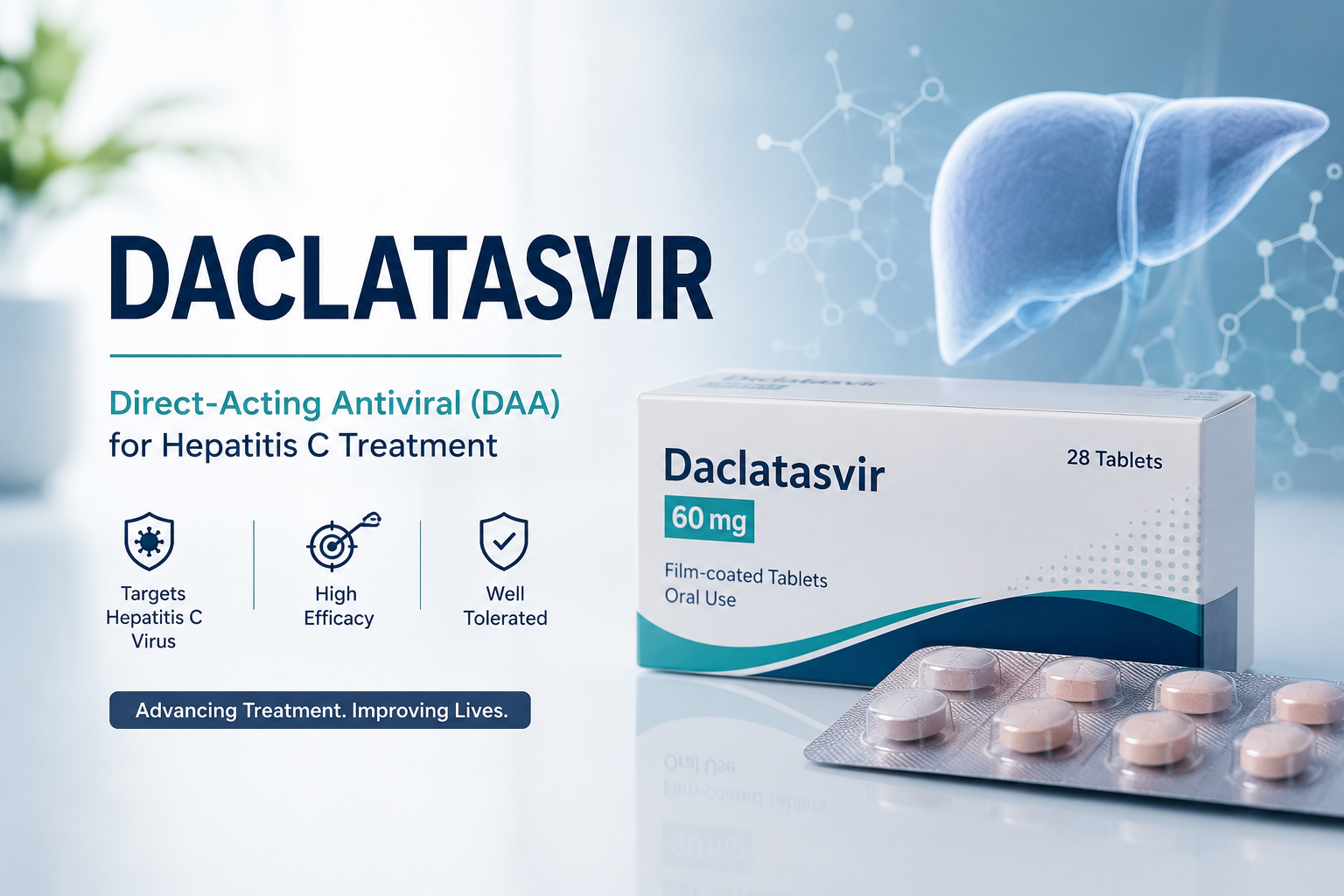


Daclatasvir (sold under the brand name Daklinza) is an advanced direct-acting antiviral (DAA) medication categorized as an HCV NS5A inhibitor. It represents a significant advancement in hepatology, serving as an essential component of modern, interferon-free treatment regimens for chronic Hepatitis C virus (HCV) infection.
By binding to the viral NS5A complex, Daclatasvir prevents the Hepatitis C virus from replicating its genetic material and assembling new viral particles. When paired with complementary antivirals, it offers high cure rates, shortened treatment durations, and a favorable safety profile.
What is Daclatasvir Used For?
Daclatasvir is prescribed for adult patients for the treatment and curative management of chronic Hepatitis C virus (HCV) infection:
• Target Genotypic Coverage: Approved for HCV Genotypes 1 and 3, and extensively utilized globally across Genotypes 2, 4, 5, and 6 in pan-genotypic regimens.
• Combination Therapy Backbone: Administered alongside other direct-acting antivirals—most notably Sofosbuvir—with or without Ribavirin.
• Diverse Clinical Profiles: Indicated for patients without cirrhosis, patients with compensated or decompensated cirrhosis, individuals co-infected with HIV-1, and post-liver transplant recipients.
How Does Daclatasvir Work?
In host liver cells (hepatocytes), the Hepatitis C virus relies on its non-structural 5A (NS5A) protein to build replication complexes and assemble new viruses. Daclatasvir operates through a precise molecular mechanism:
• Targeted Protein Inhibition: Daclatasvir binds directly to the N-terminus of the NS5A domain, a critical protein required for both viral RNA replication and virion assembly.
• Replication Complex Disruption: By blocking NS5A, Daclatasvir alters the localized cellular structure necessary for HCV RNA replication, halting the production of new viral genomic strands.
• Dual Blockade: In addition to stopping RNA synthesis, it inhibits the final assembly and release of infectious HCV particles. When combined with an NS5B inhibitor like Sofosbuvir, it attacks the virus from two distinct angles, rapidly clearing HCV from the bloodstream.
Benefits of Daclatasvir
• High Cure Rates (SVR12): Achieves Sustained Virologic Response (cure) in over 90–95% of patients across major HCV genotypes when combined with Sofosbuvir.
• Interferon-Free & Well-Tolerated: Replaces historical injectable interferon regimens, avoiding severe side effects like depression, flu-like symptoms, and bone marrow suppression.
• No Dose Adjustment in Renal or Hepatic Impairment: Daclatasvir requires no baseline dose adjustments for patients with renal impairment or mild-to-severe hepatic impairment.
Available Strengths & Dosing Adjustments
Daclatasvir is manufactured as single-agent film-coated oral tablets, providing dosing flexibility for specific drug-drug interactions:
Single-Agent Formulations
• 60 mg film-coated tablets (Standard daily adult dose)
• 30 mg film-coated tablets (Dose reduction for co-administration with strong CYP3A inhibitors)
• 90 mg film-coated tablets (Dose escalation for co-administration with moderate CYP3A inducers)
Recommended Dosage & Administration
Daclatasvir is always administered in combination with other antiviral agents; it is never used as a monotherapy.
Standard Adult Dosage Guidelines
• Standard Daily Dose: One 60 mg tablet taken orally once daily.
• Treatment Duration: Typically 12 to 24 weeks, depending on HCV genotype, baseline cirrhosis status, prior treatment history, and the presence of Ribavirin.
Administration Rules
• With or Without Food: Can be taken with or without meals.
• Swallow Whole: Swallow the tablet whole with water.
• Consistency is Key: Take your daily dose at approximately the same time every day to maintain steady antiviral drug levels in your system.
Missed Dose
• If a dose is missed within the same day, take it as soon as remembered and resume your normal daily schedule. Skip the missed dose if it is almost time for the next scheduled dose. Do not take two doses at once.
Common & Serious Side Effects
Daclatasvir alone is exceptionally well-tolerated. Most observed side effects depend on whether Ribavirin is included in the treatment regimen:
• Common Mild Effects (without Ribavirin): Headache, fatigue/unusual tiredness, nausea, and diarrhea.
• Common Effects (with Ribavirin): Fatigue, headache, nausea, insomnia, and anemia.
• Hepatitis B Reactivation (Boxed Warning): Risk of severe acute flare-up or reactivation of Hepatitis B virus (HBV) in patients co-infected with HBV and HCV. All patients must be screened for active or prior HBV infection before starting therapy.
• Severe Symptomatic Bradycardia: Co-administration of Daclatasvir + Sofosbuvir with amiodarone (an antiarrhythmic) can cause life-threatening slowing of the heart rate (bradycardia), sometimes requiring pacemaker intervention.
Drug Interactions
Daclatasvir is metabolized by liver enzyme CYP3A4 and is a substrate of the P-glycoprotein (P-gp) transporter:
• Strong CYP3A/P-gp Inducers (Contraindicated): Drugs like rifampin, carbamazepine, phenytoin, oxcarbazepine, and St. John’s Wort significantly decrease Daclatasvir blood concentrations, leading to treatment failure.
• Strong CYP3A Inhibitors: Requires a dose reduction of Daclatasvir to 30 mg once daily when used with drugs like ketoconazole, itraconazole, clarithromycin, or ritonavir-boosted protease inhibitors.
• Moderate CYP3A Inducers: Requires a dose increase of Daclatasvir to 90 mg once daily when used with drugs like efavirenz, etravirine, or dexamethasone.
• Amiodarone: Concomitant use with Daclatasvir and Sofosbuvir is strongly disadvised due to risks of severe, symptomatic bradycardia.
Pregnancy and Breastfeeding
• Daclatasvir + Sofosbuvir Combinations: Human pregnancy data are limited. Treatment is generally deferred until after delivery unless immediate therapy is clinically necessary.
• Regimens with Ribavirin: If Ribavirin is co-administered with Daclatasvir, it carries an extreme risk of severe birth defects and embryo-fetal death. Strict double contraception is mandatory for female patients and male partners during treatment and for 6 months post-treatment.
• Breastfeeding: It is unknown whether Daclatasvir passes into human breast milk. Consult your treating physician to weigh clinical benefits against potential infant risk.
Monitoring During Treatment
Regular clinical evaluations ensure optimal safety and confirm complete viral clearance:
• HBV Screening: Baseline testing for HBsAg and anti-HBc prior to initiating treatment to assess HBV reactivation risk.
• HCV RNA Quantification: Serum HCV RNA tests at baseline and 12 weeks post-treatment to confirm Sustained Virologic Response (SVR12 = cure).
• Liver & Blood Function Tests: Periodic monitoring of serum transaminases (ALT/AST), total bilirubin, and complete blood counts (especially if taking Ribavirin).
Generic Daclatasvir
Generic formulations of Daclatasvir are produced globally in compliance with strict international pharmaceutical standards:
• Cost-Effectiveness: Provides an affordable, highly accessible treatment alternative compared to brand-name Daklinza.
• Therapeutic Equivalence: Formulated with the identical active pharmaceutical ingredient (API), delivering bioequivalent viral suppression rates, safety profiles, and cure success.
• Global HCV Elimination: Plays a vital role alongside generic Sofosbuvir in global public health initiatives aiming to eradicate Hepatitis C worldwide.
Frequently Asked Questions (FAQs)
Can Daclatasvir be taken alone without other Hepatitis C drugs?
No. Daclatasvir must always be combined with at least one other direct-acting antiviral (most commonly Sofosbuvir) with or without Ribavirin. Monotherapy with Daclatasvir is ineffective and leads to viral resistance.
What does "SVR12" mean in Hepatitis C treatment?
SVR12 stands for Sustained Virologic Response at 12 weeks. It means that no Hepatitis C virus is detected in your blood 12 weeks after finishing the full medication course, which indicates that the infection is clinically cured.
Can I drink alcohol while taking Daclatasvir?
Alcohol should be completely avoided during treatment for Hepatitis C. Alcohol accelerates liver inflammation and damage, counteracting the healing benefits of clearing the virus.
Important Safety Information
This article is intended for educational purposes only and does not substitute for expert medical advice. Always consult a qualified hepatologist, gastroenterologist, or infectious disease specialist before initiating, adjusting, or stopping Hepatitis C therapy.
References
• U.S. Food and Drug Administration (FDA) Prescribing Information (Daklinza / Daclatasvir)
• World Health Organization (WHO) Guidelines for the Care and Treatment of Persons Diagnosed with Chronic Hepatitis C Infection
• European Association for the Study of the Liver (EASL) Recommendations on Treatment of Hepatitis C
• American Association for the Study of Liver Diseases (AASLD) / Infectious Diseases Society of America (IDSA) HCV Guidance
Contact Us
Are you searching for Generic Daclatasvir, wholesale pricing structures, global availability, or export documentation?
Our expert team is fully equipped to guide you through trusted manufacturer selections, product availability, international licensing, and country-specific import regulations. Contact us today to learn more.
What is Daclatasvir?
Daclatasvir (sold under the brand name Daklinza) is an advanced direct-acting antiviral (DAA) medication categorized as an HCV NS5A inhibitor. It represents a significant…