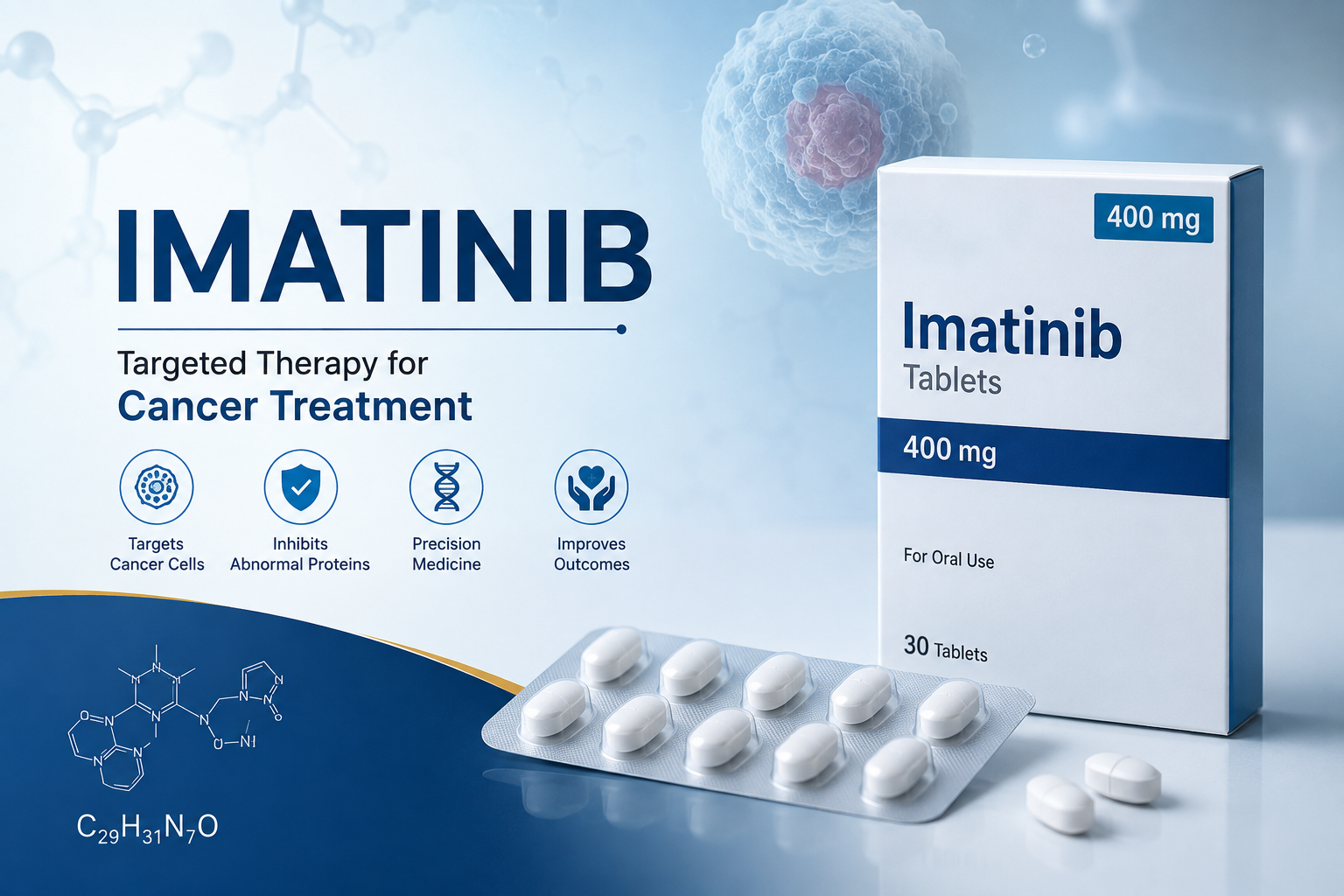


Imatinib (sold under brand names such as Gleevec and Glivec) is a landmark targeted antineoplastic medication categorized as a first-generation tyrosine kinase inhibitor (TKI). It revolutionized modern oncology as one of the first successful examples of precision targeted therapy, transforming once-fatal blood cancers into manageable chronic conditions.
By selectively targeting and inhibiting specific abnormal tyrosine kinase enzymes that drive uncontrolled cellular proliferation, Imatinib halts cancer progression while sparing most healthy cells.
What is Imatinib Used For?
Imatinib is indicated for adult and pediatric patients for the treatment and management of several specific hematologic malignancies and solid tumors:
• Chronic Myeloid Leukemia (CML): First-line therapy for newly diagnosed Philadelphia chromosome-positive ($Ph^+$) CML in chronic, accelerated, or blast phases.
• Philadelphia Chromosome-Positive Acute Lymphoblastic Leukemia ($Ph^+$ ALL): Treatment for adult and pediatric patients with relapsed, refractory, or newly diagnosed $Ph^+$ ALL (often combined with chemotherapy).
• Gastrointestinal Stromal Tumors (GIST): Treatment for adult patients with $Kit$ ($CD117$)-positive unresectable, metastatic, or post-surgical recurrent GIST.
• Myelodysplastic / Myeloproliferative Diseases (MDS/MPD): Associated with $PDGFR$ (platelet-derived growth factor receptor) gene re-arrangements.
• Hypereosinophilic Syndrome (HES) / Chronic Eosinophilic Leukemia (CEL): Expressing $FIP1L1\text{-}PDGFR\alpha$ fusion kinase.
• Dermatofibrosarcoma Protuberans (DFSP): Unresectable, recurrent, or metastatic dermatofibrosarcoma protuberans.
How Does Imatinib Work?
Many cancers targeted by Imatinib are caused by genetic mutations that create hyperactive fusion proteins or mutated receptor kinases. Imatinib operates through a highly selective molecular mechanism:
• Inhibition of $Bcr\text{-}Abl$ Tyrosine Kinase: In $Ph^+$ leukemia, a chromosome translocation forms the abnormal $Bcr\text{-}Abl$ fusion gene. Imatinib binds reversibly to the adenosine triphosphate (ATP)-binding pocket of the $Bcr\text{-}Abl$ protein, blocking ATP binding and preventing autophosphorylation.
• Inhibition of $c\text{-}KIT$ and $PDGFR$: Similarly, Imatinib targets and blocks mutated receptor tyrosine kinases $c\text{-}KIT$ (in GIST) and $PDGFR$ (in certain myeloproliferative disorders).
• Apoptosis & Proliferation Arrest: Shutting down these intracellular signaling cascades halts abnormal cell division and triggers programmed cell death (apoptosis) in kinase-dependent malignant cells.
Benefits of Imatinib
• Targeted Cancer Therapy: Specifically targets driver mutations ($Bcr\text{-}Abl$, $c\text{-}KIT$, $PDGFR$), resulting in significantly higher response rates and fewer side effects compared to traditional cytotoxic chemotherapy.
• High Remission Rates: Delivers complete cytogenetic and deep molecular responses in over 80–90% of chronic-phase CML patients.
• Oral Daily Regimen: Administered as an oral tablet, allowing convenient outpatient management.
Available Strengths
Imatinib is manufactured as single-agent film-coated oral tablets or capsules (typically as Imatinib Mesylate):
• 100 mg film-coated tablets / capsules
• 400 mg film-coated tablets
Recommended Dosage & Administration
Dosing depends on the specific cancer type, phase of disease, body surface area (for pediatric patients), and individual tolerance.
Standard Adult Dosage Guidelines
• Chronic Phase CML: 400 mg orally once daily.
• Accelerated Phase or Blast Crisis CML / $Ph^+$ ALL: 600 mg to 800 mg orally daily (800 mg is given as 400 mg twice daily).
• Gastrointestinal Stromal Tumors (GIST): 400 mg to 600 mg orally once daily.
Crucial Administration Rules
• Take With Food and Water: Must be taken with a meal and a large glass of water (approx. 8 oz / 240 mL) to reduce gastrointestinal irritation and stomach upset.
• Administration Options: Tablets can be dissolved in a glass of water or apple juice for patients with swallowing difficulties (stir until dissolved and drink immediately).
• Consistency: Take your daily dose at approximately the same time every day to maintain steady blood drug levels.
Missed Dose
• Take the missed dose as soon as remembered on the same day with a meal and water. If it is almost time for the next scheduled dose, skip the missed dose and resume your regular daily schedule. Do not double the dose.
Common & Serious Side Effects
Imatinib exhibits a distinct safety profile associated with kinase inhibition and mild fluid retention:
• Common Side Effects:
o Fluid Retention / Edema: Periorbital (eye) puffiness, swollen ankles, lower limb edema, and weight gain.
o Gastrointestinal Symptoms: Nausea, vomiting, diarrhea, abdominal pain, and loss of appetite.
o Musculoskeletal: Muscle cramps, joint pain (arthralgia), bone pain, and muscle spasms.
o Dermatologic: Superficial skin rashes, itching, and dry skin.
• Serious Warnings & Precautions:
o Severe Fluid Retention & Effusions: Risk of severe fluid accumulation, including pleural effusion, pericardial effusion, pulmonary edema, or ascites.
o Myelosuppression: Can cause severe anemia, neutropenia, and thrombocytopenia. Regular blood count monitoring is essential.
o Hepatotoxicity: Risk of severe liver damage, elevated transaminases (ALT, AST), or hyperbilirubinemia.
o Congestive Heart Failure / Cardiac Dysfunction: Rare cases of severe cardiac dysfunction or left ventricular dysfunction.
Drug Interactions
Imatinib is primarily metabolized by the liver enzyme CYP3A4 and acts as an inhibitor of CYP3A4, CYP2D6, and CYP2C9:
• Strong CYP3A4 Inhibitors: Medications like ketoconazole, itraconazole, clarithromycin, or grapefruit juice increase Imatinib exposure and toxicity.
• Strong CYP3A4 Inducers: Drugs like rifampin, carbamazepine, phenytoin, and St. John's Wort significantly decrease Imatinib blood levels, risking treatment failure.
• CYP3A4 / CYP2C9 Substrates: Imatinib can increase blood levels of drugs metabolized by CYP3A4 or CYP2C9 (e.g., warfarin, simvastatin, cyclosporine), requiring dose monitoring.
• Acetaminophen / Paracetamol: Concurrent use requires caution due to potential increased risk of hepatotoxicity.
Pregnancy and Breastfeeding
• Pregnancy Warning: Imatinib can cause fetal harm, birth defects, or pregnancy loss when administered to pregnant women. Females of reproductive potential must undergo pregnancy testing prior to initiation and use effective contraception during treatment and for at least 14 days after the final dose.
• Breastfeeding: Imatinib and its active metabolites pass into breast milk. Breastfeeding is contraindicated during treatment and for at least 1 month after the last dose.
Monitoring During Treatment
Therapy requires ongoing laboratory and clinical evaluations:
• Complete Blood Count (CBC): Weekly during the first month, biweekly during the second month, and periodically thereafter to detect myelosuppression.
• Liver & Renal Function Tests: Monthly monitoring of transaminases (ALT, AST), total bilirubin, serum creatinine, and electrolytes.
• Weight & Fluid Status: Regular body weight checks to detect early signs of fluid retention.
• Quantitative PCR (qPCR): Periodic molecular testing of blood or bone marrow ($Bcr\text{-}Abl1$ transcript levels) to evaluate treatment response and disease clearance.
Generic Imatinib
Generic Imatinib Mesylate is globally available following the patent expiration of original Gleevec/Glivec:
• Cost-Effectiveness: Substantially lowers overall oncology care costs for patients and health delivery systems.
• Therapeutic Bioequivalence: Delivers equivalent active pharmaceutical ingredient (API), bioequivalent pharmacokinetic profiles, and matching clinical response rates.
Frequently Asked Questions (FAQs)
Why does my face look puffy in the morning while taking Imatinib?
Periorbital edema (swelling around the eyes) is one of the most common side effects of Imatinib, caused by mild fluid retention. Elevating your head with extra pillows while sleeping and reducing dietary salt can help. Consult your oncologist if swelling extends to your legs or causes sudden weight gain.
Why is it essential to take Imatinib with a full meal?
Taking Imatinib on an empty stomach frequently causes severe nausea, stomach pain, and vomiting. Taking your dose with a full meal and a large glass of water protects your stomach lining and improves drug tolerance.
How long do patients usually stay on Imatinib treatment?
For conditions like chronic-phase CML, Imatinib treatment is typically a long-term, daily therapy continued indefinitely as long as it remains effective and well-tolerated, or until a doctor confirms deep molecular response under structured management protocols.
Important Safety Information
This document is intended strictly for educational purposes and does not substitute for professional medical advice, diagnosis, or treatment. Always consult a qualified oncologist or healthcare provider regarding cancer treatment plans or medication adjustments.
References
• U.S. Food and Drug Administration (FDA) Prescribing Information (Gleevec / Imatinib Mesylate)
• National Center for Biotechnology Information (NCBI) StatPearls: Imatinib Pharmacology
• National Comprehensive Cancer Network (NCCN) Guidelines for Chronic Myeloid Leukemia & GIST
• European Society for Medical Oncology (ESMO) Clinical Practice Guidelines for CML and GIST
Contact Us
Are you searching for Generic Imatinib Mesylate, wholesale distribution options, global product availability, or export documentation?
Our expert team is fully equipped to assist you with manufacturer verification, bulk availability, international licensing, and country-specific import compliance. Contact us today to learn more.
What is Imatinib?
Imatinib (sold under brand names such as Gleevec and Glivec) is a landmark targeted antineoplastic medication categorized as a first-generation tyrosine kinase inhibitor…