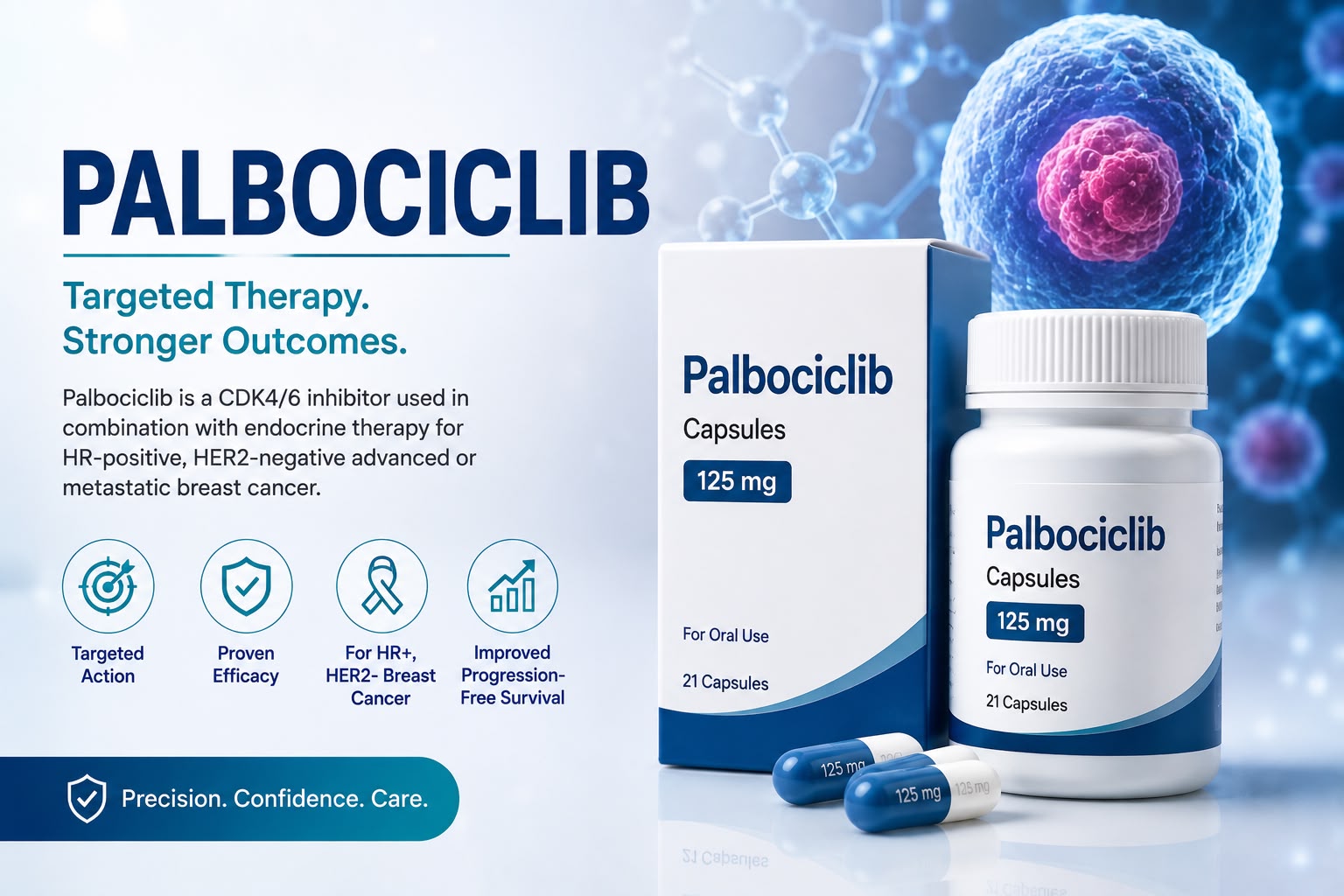


Palbociclib is a targeted therapy categorized as a selective CDK4/6 (cyclin-dependent kinase 4 and 6) inhibitor. It is used for treating specific types of advanced or metastatic breast cancers. As a precision medicine, it disrupts the division of cancer cells, slowing down tumor progression and improving progression-free survival while presenting a different side-effect profile compared to conventional chemotherapy.
What is Palbociclib Used For?
Palbociclib is indicated for adults with hormone receptor-positive (HR+), human epidermal growth factor receptor 2-negative (HER2-) advanced or metastatic breast cancer. It is used in several clinical settings, including:
• First-line endocrine therapy: In combination with an aromatase inhibitor (e.g., letrozole, anastrozole) as initial endocrine-based therapy in postmenopausal women or men.
• Second-line/Prior therapy progression: In combination with fulvestrant for patients whose cancer has progressed after receiving endocrine therapy.
• Maintenance therapy (HR+/HER2+): Approved in combination with trastuzumab (with or without pertuzumab) and endocrine therapy for the maintenance treatment of adults with HR+/HER2+ locally advanced or metastatic breast cancer.
Treatment should always be personalized based on hormone receptor status, HER2 status, disease stage, overall health, and oncology guidelines.
How Does Palbociclib Work?
In many breast cancers, the CDK4 and CDK6 proteins are overactivated, sending continuous signals that instruct cancer cells to multiply and divide rapidly.
Palbociclib works by selectively blocking these proteins. This action:
• Arrests the cell cycle: It stops cancer cells from transitioning from the growth phase (G1) to the replication phase (S), effectively halting cell division.
• Delays tumor progression: By freezing the multiplication process, it slows down overall cancer growth.
• Works synergistically: Combined with hormone therapies (like aromatase inhibitors or fulvestrant), it blocks multiple pathways simultaneously, preventing the cancer cells from bypassing hormone-blocking treatments.
Unlike traditional chemotherapy which attacks all rapidly dividing cells indiscriminately, Palbociclib targets the specific biological pathways driving cancer growth.
Benefits of Palbociclib
Clinical trials have shown several key benefits when Palbociclib is incorporated into a treatment regimen:
• Highly effective: Delays cancer progression significantly when combined with hormonal therapy.
• Extended progression-free survival: Helps keep the cancer stable and controlled for longer periods.
• Oral administration: Taken once daily as a capsule or tablet, offering outpatient convenience.
• Targeted profile: Avoids many of the classic side effects associated with standard chemotherapy.
Available Strengths
Palbociclib is commonly available in the following oral strengths:
• 75 mg capsules/tablets
• 100 mg capsules/tablets
• 125 mg capsules/tablets
The appropriate dose and strength are determined by your oncologist.
Recommended Dosage & Cycle
The typical recommended adult starting dose is 125 mg orally once daily. Palbociclib is administered in a cyclical regimen:
1.21 days of treatment:Days 1 to 21.
Take one tablet/capsule (usually 125 mg) at the same time each day for 21 consecutive days. If using capsules, they must be taken with food. Tablets can be taken with or without food.
2.7 days off treatment:Days 22 to 28.
Do not take any Palbociclib for 7 consecutive days. This allows your body's blood counts to recover.
3.Repeat the cycle:Day 29 onwards.
Start the next 28-day cycle exactly as scheduled, unless directed otherwise by your oncologist.
Missed Dose
If you miss a dose of Palbociclib:
• Do not take an extra dose to make up for the missed one.
• Skip the missed dose entirely and take your next dose at your regularly scheduled time.
• If you vomit after taking a dose, do not take an additional dose. Just wait and take your next scheduled dose.
Common Side Effects
While Palbociclib is generally well-tolerated compared to traditional chemotherapy, it does have a distinct side effect profile:
• Neutropenia (low white blood cell counts): The most common side effect, which increases the risk of infection.
• Anemia & Thrombocytopenia: Low red blood cell and platelet counts.
• Fatigue and generalized weakness
• Nausea, diarrhea, and vomiting
• Mouth sores (stomatitis)
• Hair thinning or mild hair loss
• Dry skin and rashes
Drug Interactions
Certain drugs and substances can alter the levels of Palbociclib in your body, potentially making it less effective or increasing toxic side effects. Inform your doctor if you take:
• Strong CYP3A inhibitors (e.g., ketoconazole, clarithromycin, grapefruit juice)—these can increase Palbociclib levels.
• Strong CYP3A inducers (e.g., rifampin, phenytoin, St. John’s Wort)—these can decrease Palbociclib levels.
Pregnancy and Breastfeeding
• Embryo-Fetal Toxicity: Palbociclib can cause fetal harm. Effective contraception must be used by both female and male patients (with female partners of reproductive potential) during treatment and for a specified time after the final dose.
• Breastfeeding: It is recommended to avoid breastfeeding during treatment and for a period after the last dose.
Monitoring During Treatment
Due to the risk of bone marrow suppression, your oncology team will monitor your blood levels regularly:
• Complete Blood Counts (CBC): Checked prior to starting, at the beginning of each cycle, and on Day 15 of the first two cycles.
• Infection monitoring: Periodic assessments for signs of infection (fever, chills).
• Lung function: Monitoring for rare but serious pulmonary issues like pneumonitis or interstitial lung disease (ILD).
Generic Palbociclib
Generic formulations of Palbociclib are produced globally by several manufacturers under stringent bioequivalence standards.
• Cost-effectiveness: Provides a significantly more affordable option compared to the original brand-name drug (Ibrance).
• Therapeutic equivalence: Contains the identical active pharmaceutical ingredient, offering the same clinical efficacy and safety profile.
• Wider availability: Available internationally, allowing broader patient access to essential advanced breast cancer care.
Frequently Asked Questions (FAQs)
Is Palbociclib a type of chemotherapy?
No. Palbociclib is a targeted therapy (specifically a CDK4/6 inhibitor). It selectively targets cancer cell pathways, leading to different side effects than classic chemotherapy.
Can Palbociclib cure advanced breast cancer?
While it is not considered a cure for metastatic breast cancer, it is highly effective at controlling tumor growth, shrinking lesions, and delaying disease progression for significant periods.
Do I need to take it with food?
If you are taking Palbociclib capsules, they must be taken with food to ensure consistent absorption. If you are taking the tablet formulation, it can be taken with or without food.
Important Safety Information
This information is for educational purposes only and should not replace professional medical advice. Always consult a qualified oncologist before starting, modifying, or stopping Palbociclib therapy.
References
• U.S. Food and Drug Administration (FDA) Prescribing Information
• National Comprehensive Cancer Network (NCCN) Guidelines
• European Medicines Agency (EMA) Drug Information
• American Society of Clinical Oncology (ASCO)
Contact Us
Are you looking for Generic Palbociclib, wholesale pricing, international availability, or export documentation?
Our team can assist you with product availability, manufacturer options, required licensing, and country-specific importation policies. Contact us to find out more.
What is Palbociclib?
Palbociclib is a targeted therapy categorized as a selective CDK4/6 (cyclin-dependent kinase 4 and 6) inhibitor. It is used for treating specific types of advanced or met…