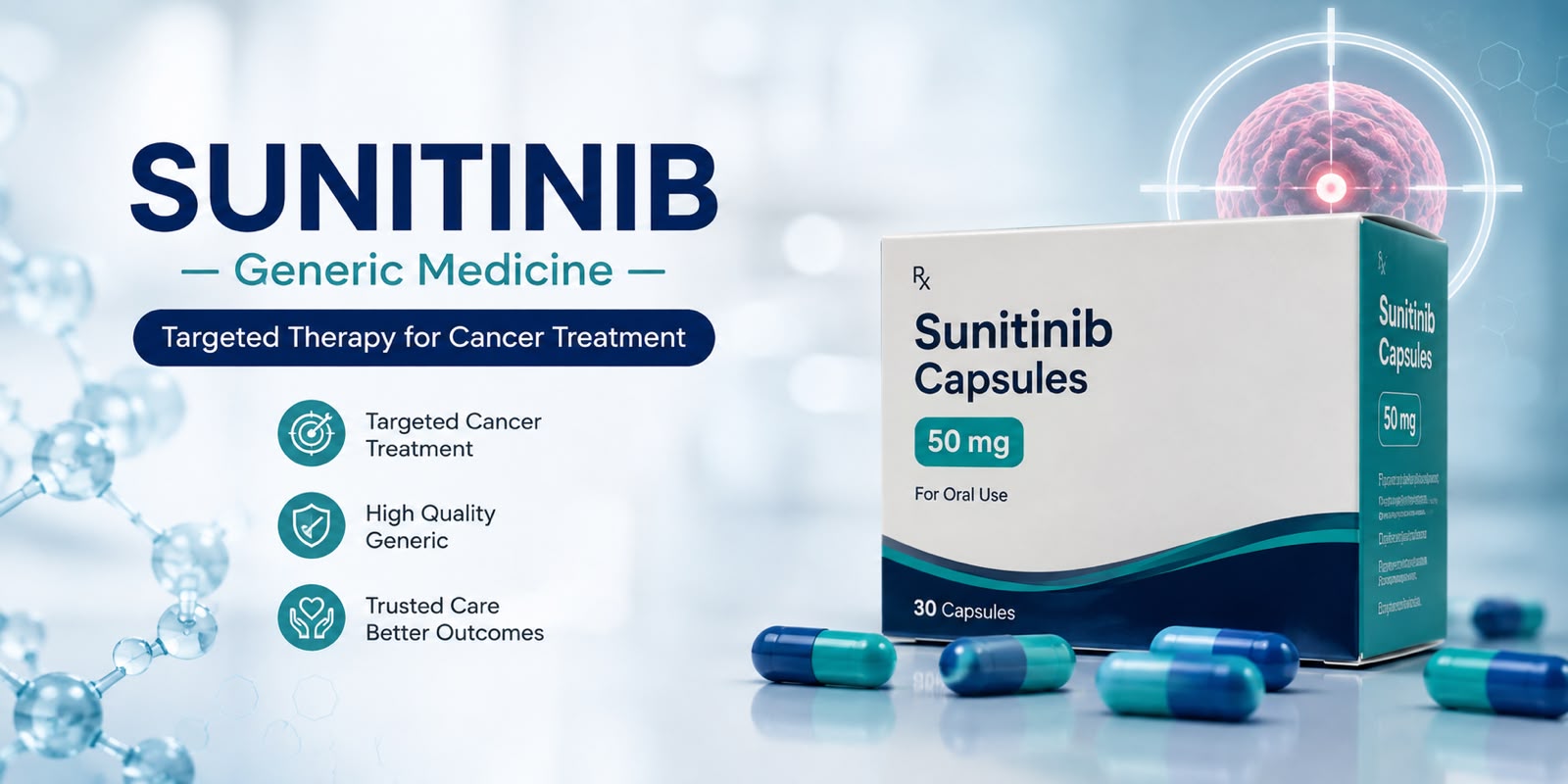


Sunitinib (commonly administered as Sunitinib Malate) is an advanced targeted anticancer therapy categorized as a multi-targeted receptor tyrosine kinase inhibitor (TKI). It belongs to a modern class of precision oncology agents designed to block specific molecular pathways responsible for tumor growth, cell division, and new blood vessel formation.
Unlike traditional cytotoxic chemotherapy that broadly attacks rapidly dividing cells, Sunitinib is engineered to directly target key growth factor receptors on cancer cells and supporting blood vessel walls. This targeted mechanism starves tumors of essential nutrients and oxygen, delivering potent antitumor efficacy with a distinct clinical safety profile.
What is Sunitinib Used For?
Sunitinib is prescribed for adult patients for the management of specific advanced, recurrent, or metastatic solid tumors. Its primary clinical indications include:
• Advanced Renal Cell Carcinoma (RCC): Approved as a first-line treatment for patients living with advanced or metastatic kidney cancer.
• Adjuvant Treatment of Renal Cell Carcinoma (RCC): Used as a follow-up treatment for adult patients at high risk of cancer recurrence after undergoing a nephrectomy (surgical removal of the kidney).
• Gastrointestinal Stromal Tumor (GIST): Prescribed for the treatment of GIST in patients whose disease has progressed during treatment with Imatinib mesylate, or who are intolerant to Imatinib.
• Advanced Pancreatic Neuroendocrine Tumors (pNET): Approved for progressive, well-differentiated, unresectable locally advanced or metastatic pancreatic neuroendocrine tumors.
How Does Sunitinib Work?
In solid tumors, key receptor tyrosine kinases drive cell survival, rapid proliferation, and the formation of new tumor-supplying blood vessels (angiogenesis). Sunitinib operates through a multi-targeted molecular mechanism:
• Targeted Kinase Inhibition: Sunitinib selectively blocks multiple intracellular receptor tyrosine kinases, including Vascular Endothelial Growth Factor Receptors (VEGFR-1, VEGFR-2, VEGFR-3), Platelet-Derived Growth Factor Receptors (PDGFR-$\alpha$, PDGFR-$\beta$), and the Stem Cell Factor Receptor (KIT).
• Anti-Angiogenesis (Blood Supply Cutoff): By inhibiting VEGFR and PDGFR pathways, Sunitinib prevents the tumor from establishing new blood vessels, effectively cutting off the oxygen and nutrient supply required for malignant growth.
• Induction of Apoptosis: Blocking KIT and downstream signaling pathways halts internal cell division signals, causing cancer cells to undergo programmed cell death (apoptosis) and reducing overall tumor burden.
Benefits of Sunitinib
• Proven Antitumor Efficacy: Significantly delays disease progression, prolongs progression-free survival (PFS), and shrinks tumor mass across multiple solid cancer types.
• Dual-Action Precision: Combines direct tumor growth inhibition with powerful anti-angiogenic properties to target both the tumor cells and their supportive microenvironment simultaneously.
• Convenient Oral Administration: Formulated as once-daily oral capsules, allowing patients to manage their targeted cancer treatment conveniently at home.
Available Strengths
Sunitinib is manufactured in precise hard oral capsule strengths to facilitate tailored dosing schedules and clinical dose adjustments:
• 12.5 mg capsules
• 25 mg capsules
• 37.5 mg capsules
• 50 mg capsules
Recommended Dosage & Administration
Sunitinib is administered orally according to specific cyclic or continuous treatment schedules depending on the underlying diagnosis:
• Standard Schedule for GIST and Advanced/Adjuvant RCC: One 50 mg capsule taken orally once daily for 4 consecutive weeks, followed by 2 weeks off treatment (a complete 6-week cycle, known as Schedule 4/2).
• Standard Schedule for Pancreatic Neuroendocrine Tumors (pNET): One 37.5 mg capsule taken orally once daily continuously, without a scheduled off-treatment period.
Administration Rules
• With or Without Food: Take your capsule with or without food, as food does not significantly affect systemic absorption.
• Swallow Whole: Swallow the capsule whole with a full glass of water. Do not open, crush, split, or chew the capsules.
• Consistency is Key: Take your daily dose at approximately the same time every day to maintain steady therapeutic blood concentration levels.
Missed Dose
• If a dose is missed, take it as soon as remembered on that same day.
• If it is almost time for your next scheduled dose, skip the missed dose and resume your regular daily schedule. Do not take two doses at once to make up for a missed dose.
Common & Serious Side Effects
While Sunitinib is an effective targeted therapy, specific adverse reactions require close clinical awareness and monitoring:
• Gastrointestinal Issues: Diarrhea, nausea, stomatitis (mouth sores), altered sense of taste (dysgeusia), and loss of appetite are commonly reported.
• Dermatological & Hair Changes: Hand-Foot Syndrome (palmar-plantar erythrodysesthesia causing redness, pain, or swelling on hands and feet), yellowing skin discoloration, and hair depigmentation/lightening.
• Cardiovascular Effects & Hypertension: High blood pressure is common; rare but serious cardiac events include reduced left ventricular ejection fraction (LVEF) and QT prolongation.
• Fatigue & Asthenia: General tiredness, weakness, and fatigue during active treatment weeks.
• Hematological Toxicity: Decreases in red blood cells (anemia), white blood cells (neutropenia), and platelets (thrombocytopenia), requiring routine blood work.
• Hepatotoxicity & Thyroid Dysfunction: Potential increases in liver enzymes and hypothyroidism (underactive thyroid), requiring regular lab screening.
Drug Interactions
Sunitinib is primarily metabolized by the cytochrome P450 3A4 (CYP3A4) liver enzyme. Concomitant medications can significantly alter its therapeutic levels:
• Strong CYP3A4 Inducers: (e.g., Rifampin, Carbamazepine, St. John’s Wort, Phenytoin) can dramatically increase Sunitinib metabolism, lowering plasma levels and reducing clinical efficacy.
• Strong CYP3A4 Inhibitors: (e.g., Ketoconazole, Itraconazole, Clarithromycin, Grapefruit juice) can increase Sunitinib blood concentrations, raising the risk of severe toxicity.
• QT-Prolonging Drugs: Co-administration with medications known to prolong the QT interval should be evaluated carefully by an oncologist.
Pregnancy and Breastfeeding
Warning: Sunitinib can cause fetal harm when administered to pregnant women due to its anti-angiogenic mechanism.
• Embryo-Fetal Toxicity: Women of childbearing potential must use effective contraception during treatment and for a specified period after the final dose. Male patients with female partners of reproductive potential should also use effective contraception.
• Breastfeeding: Mothers should not breastfeed during treatment with Sunitinib and for at least several weeks after the final dose due to potential serious adverse reactions in nursing infants.
Monitoring During Treatment
To ensure maximum therapeutic outcome and safety, healthcare teams perform continuous clinical evaluations:
• Blood Pressure Monitoring: Baseline and frequent ongoing blood pressure checks, initiating antihypertensive therapy if needed.
• Complete Blood Count (CBC): Routine baseline and mid-cycle testing to monitor for neutropenia, anemia, or thrombocytopenia.
• Liver & Thyroid Function Tests: Periodic liver enzyme (ALT/AST, bilirubin) and thyroid-stimulating hormone (TSH) monitoring.
• Cardiac Evaluation: Baseline and periodic electrocardiograms (ECG) and echocardiograms to evaluate QT interval and left ventricular function.
Generic Sunitinib
Generic formulations of Sunitinib Malate are manufactured globally under stringent international pharmaceutical standards:
• Cost-Effectiveness: Provides a significantly more affordable, highly accessible alternative compared to brand-name formulations (such as Sutent).
• Therapeutic Equivalence: Contains the exact active pharmaceutical ingredient (API), maintaining strict bioequivalence, safety, and clinical success.
• Global Access: Expands access to life-prolonging targeted cancer care across international healthcare systems.
Frequently Asked Questions (FAQs)
Is Sunitinib the same as traditional chemotherapy?
No. Sunitinib is a targeted therapy (tyrosine kinase inhibitor). Rather than broadly attacking all rapidly dividing cells, it specifically targets key growth signaling pathways and tumor blood supply.
Why do I take Sunitinib for 4 weeks and then stop for 2 weeks?
For kidney cancer (RCC) and GIST, the 4-weeks-on, 2-weeks-off cycle allows your body, blood counts, and healthy tissues time to recover from treatment-related toxicities before starting the next cycle.
Can Sunitinib change my skin or hair color?
Yes. It is common for Sunitinib to cause temporary lightening/yellowing of the skin or hair depigmentation during active treatment cycles. These visual changes are temporary and generally resolve after stopping or during the rest period.
Important Safety Information
This article is intended for educational purposes only and does not substitute for expert medical advice. Always consult a qualified oncologist or healthcare specialist before initiating, adjusting, or stopping Sunitinib therapy.
References
• U.S. Food and Drug Administration (FDA) Prescribing Information (Sutent / Sunitinib Malate)
• National Comprehensive Cancer Network (NCCN) Clinical Practice Guidelines in Oncology
• European Society for Medical Oncology (ESMO) Clinical Practice Guidelines
• World Health Organization (WHO) Essential Medicines Selection Criteria
Contact Us
Are you searching for Generic Sunitinib, wholesale pricing structures, global availability, or export documentation?
Our expert team is fully equipped to guide you through trusted manufacturer selections, product availability, international licensing, and country-specific import regulations. Contact us today to learn more.
What is Sunitinib?
Sunitinib (commonly administered as Sunitinib Malate) is an advanced targeted anticancer therapy categorized as a multi-targeted receptor tyrosine kinase inhibitor (TKI).…