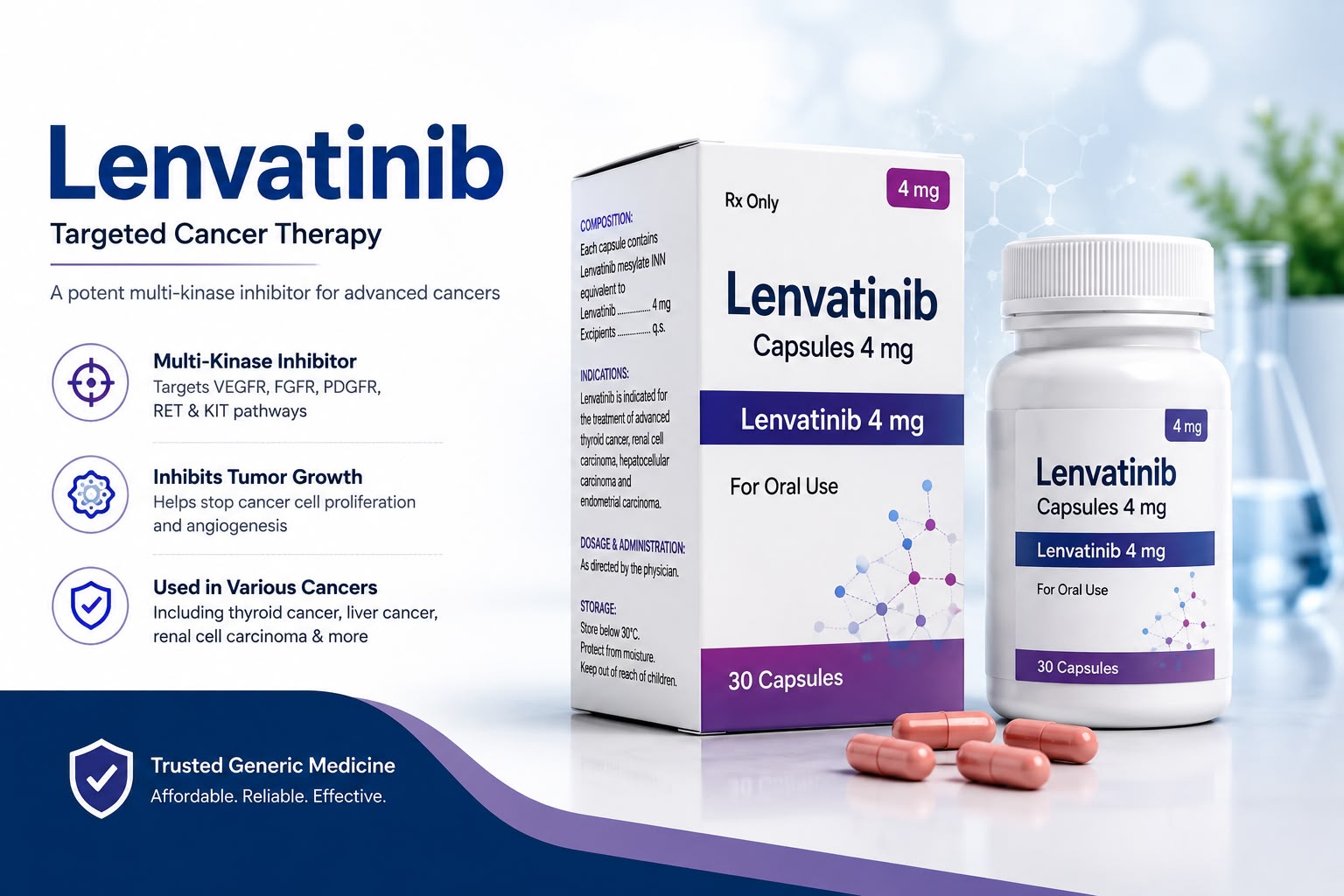


Lenvatinib (often administered as Lenvatinib Mesylate) is an advanced targeted oral antineoplastic medication categorized as a multi-targeted receptor tyrosine kinase (RTK) inhibitor. It belongs to a modern class of precision targeted agents designed to selectively block specific cell-surface receptors that promote tumor blood vessel formation (angiogenesis), cancer cell division, and tissue invasion.
Engineered to bind with high affinity to multiple angiogenic and oncogenic pathways simultaneously, Lenvatinib disrupts key intracellular signaling networks required for tumor growth and survival.
What is Lenvatinib Used For?
Lenvatinib is prescribed for adult patients for the management of several advanced, progressive, or treatment-refractory solid tumors. Its primary clinical indications include:
• Differentiated Thyroid Cancer (DTC): Approved as a monotherapy for locally recurrent or metastatic, progressive, radioactive iodine-refractory differentiated thyroid cancer.
• Advanced Renal Cell Carcinoma (RCC):
o First-line combination therapy: Used in combination with pembrolizumab for adult patients with advanced kidney cancer.
o Second-line combination therapy: Used in combination with everolimus for patients with advanced RCC following prior anti-angiogenic therapy.
• Hepatocellular Carcinoma (HCC): Approved as a first-line systemic treatment for patients with unresectable liver cancer.
• Advanced Endometrial Carcinoma (EC): Used in combination with pembrolizumab for advanced, non-MSI-H/dMMR endometrial cancer that has progressed following prior systemic therapy.
How Does Lenvatinib Work?
Solid tumors rely heavily on the construction of new capillary networks to deliver oxygen and nutrient supplies. Lenvatinib operates through a distinct multi-pathway mechanism:
• Inhibition of Angiogenic Kinases: Lenvatinib selectively inhibits Vascular Endothelial Growth Factor Receptors (VEGFR-1, VEGFR-2, VEGFR-3) and Fibroblast Growth Factor Receptors (FGFR-1, FGFR-2, FGFR-3, FGFR-4).
• Blockade of Oncogenic Drivers: Beyond VEGFR and FGFR, Lenvatinib targets PDGFR-$\alpha$, c-KIT, and RET proto-oncogenes, directly suppressing malignant signal transduction.
• Dual Action on Tumor Vasculature and Growth: By simultaneously blocking VEGFR and FGFR pathways, Lenvatinib overcomes single-target resistance, starves the tumor microenvironment of blood supply, and triggers tumor regression.
Benefits of Lenvatinib
• Broad Multi-Kinase Coverage: Simultaneous blockade of VEGFR and FGFR pathways provides enhanced anti-angiogenic potency compared to older single-pathway inhibitors.
• Proven Clinical Efficacy: Demonstrates significant improvements in progression-free survival (PFS) and overall response rates across thyroid, kidney, liver, and endometrial cancers.
• Convenient Once-Daily Oral Regimen: Formulated as an oral capsule taken once daily at home, avoiding frequent hospital-based intravenous infusions.
Available Strengths
Lenvatinib is manufactured as oral hard capsules in two primary single-capsule strengths, which are packaged individually or in combination blister packs to support distinct daily dosages:
• 4 mg oral capsules
• 10 mg oral capsules
(Standard prescribed daily doses such as 8 mg, 12 mg, 14 mg, 18 mg, 20 mg, and 24 mg are achieved by taking combinations of 4 mg and 10 mg capsules once daily as directed.)
Recommended Dosage & Administration
Dosing regimens vary substantially based on the cancer type, whether Lenvatinib is given alone or in combination, and patient body weight.
Standard Adult Dosage Guidelines
• Differentiated Thyroid Cancer (DTC): Standard starting dose is 24 mg orally once daily.
• Advanced Renal Cell Carcinoma (RCC):
o With Pembrolizumab: 20 mg orally once daily.
o With Everolimus: 18 mg orally once daily.
• Hepatocellular Carcinoma (HCC): Dosing is based on actual body weight:
o Weight $\ge$ 60 kg: 12 mg orally once daily.
o Weight < 60 kg: 8 mg orally once daily.
• Endometrial Carcinoma (EC): Standard starting dose is 20 mg orally once daily in combination with pembrolizumab.
Administration Rules
• With or Without Food: Take once daily at approximately the same time every day, with or without food.
• Oral Suspension Option: Capsules can be swallowed whole with water, or dissolved in 3 mL of water or apple juice in a small glass or syringe (without breaking or crushing) for patients who have difficulty swallowing.
Missed Dose
• If a dose is missed and cannot be taken within 12 hours, skip the missed dose and resume your regular schedule the following day. Do not take two doses at once to make up for a missed dose.
Common & Serious Side Effects
While Lenvatinib provides targeted therapeutic benefits, close clinical oversight is essential to manage potential adverse reactions:
• Hypertension (High Blood Pressure): Very common and often severe. Blood pressure should be well-controlled prior to initiation and monitored regularly during therapy.
• Gastrointestinal Toxicities: Diarrhea, nausea, stomatitis/mouth sores, abdominal pain, vomiting, and decreased appetite leading to weight loss.
• Fatigue & Dysphonia: Significant fatigue/asthenia, muscle/joint pain, and voice hoarseness or alterations.
• Palmar-Plantar Erythrodysesthesia: Redness, pain, swelling, or peeling on the palms of the hands and soles of the feet.
• Proteinuria & Renal Failure: Elevated protein levels in urine (proteinuria) and potential decline in kidney function.
• Hemorrhagic Events & Arterial Thromboembolism: Increased risk of bleeding events, stroke, or cardiac ischemia/infarction.
• QT Prolongation & Hypocalcemia: Changes in cardiac rhythm (QT prolongation) and low blood calcium levels.
Drug Interactions
Lenvatinib undergoes primary metabolism mediated by CYP3A4, aldehyde oxidase, and non-enzymatic pathways:
• Inhibitors & Inducers of CYP3A: Strong CYP3A4 inhibitors or inducers have minimal effect on overall Lenvatinib plasma concentration compared to pure enzymatic drugs, but caution remains recommended.
• QT-Prolonging Medications: Concurrent use with other drugs known to prolong the QT interval requires close cardiac monitoring (ECG) and electrolyte stabilization.
• Antihypertensive Agents: Frequent initiation or adjustment of blood pressure medications is often required during Lenvatinib therapy.
Pregnancy and Breastfeeding
• Embryo-Fetal Toxicity: Lenvatinib causes severe fetal harm, teratogenicity, and embryo-fetal mortality due to its potent anti-angiogenic activity. Females of reproductive potential must use effective contraception during treatment and for at least 30 days after the final dose. Male patients with female partners of childbearing potential should also use effective contraception.
• Breastfeeding: Breastfeeding is not recommended during Lenvatinib treatment and for at least 1 week following the last dose.
Monitoring During Treatment
Routine clinical evaluations are required throughout treatment to maintain safety and optimize clinical efficacy:
• Blood Pressure Tracking: Weekly monitoring for the first two months, followed by at least monthly checks thereafter.
• Urinalysis: Baseline and periodic monitoring for proteinuria (dipstick or 24-hour urine protein assessments).
• Thyroid Function Tests: Serum TSH levels monitored baseline and monthly due to a high risk of drug-induced hypothyroidism.
• Serum Electrolytes & Calcium: Baseline and periodic checks of blood calcium, potassium, and magnesium.
• Hepatic & Renal Function: Serum transaminases (ALT, AST), bilirubin, creatinine, and eGFR evaluations.
Generic Lenvatinib
Generic formulations of Lenvatinib Mesylate are produced globally in compliance with strict international pharmaceutical standards:
• Cost-Effectiveness: Provides an affordable, highly accessible treatment alternative compared to the brand-name formulation (Lenvima).
• Therapeutic Equivalence: Contains the identical active pharmaceutical ingredient (API), delivering bioequivalent efficacy, quality, and clinical results.
• Global Access: Expands affordable chronic oncology treatment access for patients and healthcare institutions worldwide.
Frequently Asked Questions (FAQs)
Is Lenvatinib a form of traditional chemotherapy?
No. Lenvatinib is a targeted therapy (receptor tyrosine kinase inhibitor). Unlike conventional chemotherapy that broadly targets fast-dividing cells, Lenvatinib selectively targets proteins involved in tumor blood supply and oncogenic signaling pathways.
What should I do if I cannot swallow Lenvatinib capsules whole?
Lenvatinib capsules can be dissolved without crushing or opening. Place the intact capsules into a small glass containing 3 mL of water or apple juice, wait 10 minutes for the capsule shell to disintegrate, stir for 3 minutes, and drink immediately. Rinse the glass with an additional 2 mL of liquid and drink to ensure the full dose is ingested.
What happens if my blood pressure rises while taking Lenvatinib?
Elevated blood pressure is a common effect of VEGFR inhibitors. Your oncology care team will monitor your blood pressure closely and start or adjust anti-hypertensive medication if needed. If blood pressure remains high, your dose may be temporarily paused or reduced.
Important Safety Information
This article is intended for educational purposes only and does not substitute for expert medical advice. Always consult a qualified oncologist or healthcare specialist before initiating, adjusting, or stopping Lenvatinib therapy.
References
• U.S. Food and Drug Administration (FDA) Prescribing Information (Lenvima / Lenvatinib)
• National Comprehensive Cancer Network (NCCN) Clinical Practice Guidelines in Oncology
• European Society for Medical Oncology (ESMO) Clinical Practice Guidelines
Contact Us
Are you searching for Generic Lenvatinib, wholesale pricing structures, global availability, or export documentation?
Our expert team is fully equipped to guide you through trusted manufacturer selections, product availability, international licensing, and country-specific import regulations. Contact us today to learn more.
What is Lenvatinib?
Lenvatinib (often administered as Lenvatinib Mesylate) is an advanced targeted oral antineoplastic medication categorized as a multi-targeted receptor tyrosine kinase (RT…